
Smyrna Wood Flooring repairs termite damage in hardwood floors across Smyrna, GA, drawing on more than 20 years of floor work, serving surrounding cities including Vinings, Fair Oaks, Mableton, Marietta and Austell. Once the pest control company has treated the house, we cut out every damaged board, repair the subfloor beneath it, and weave in matched wood so the floor is sound again. We never fill termite damage or cover it over.
Subterranean termites are common in Georgia, and they work out of sight. They travel through mud tubes from the soil into the wood, eat it from the inside, and leave a thin shell on the surface. By the time a floor shows damage, the boards underneath are often more hollow than they look.
That is why termite repair starts with finding the full extent of the damage rather than patching what shows. We open the floor, check the subfloor and joists, and write a repair scope based on what is actually there.
Signs of Termite Damage in Wood Floors
Hollow Spots and Soft Boards
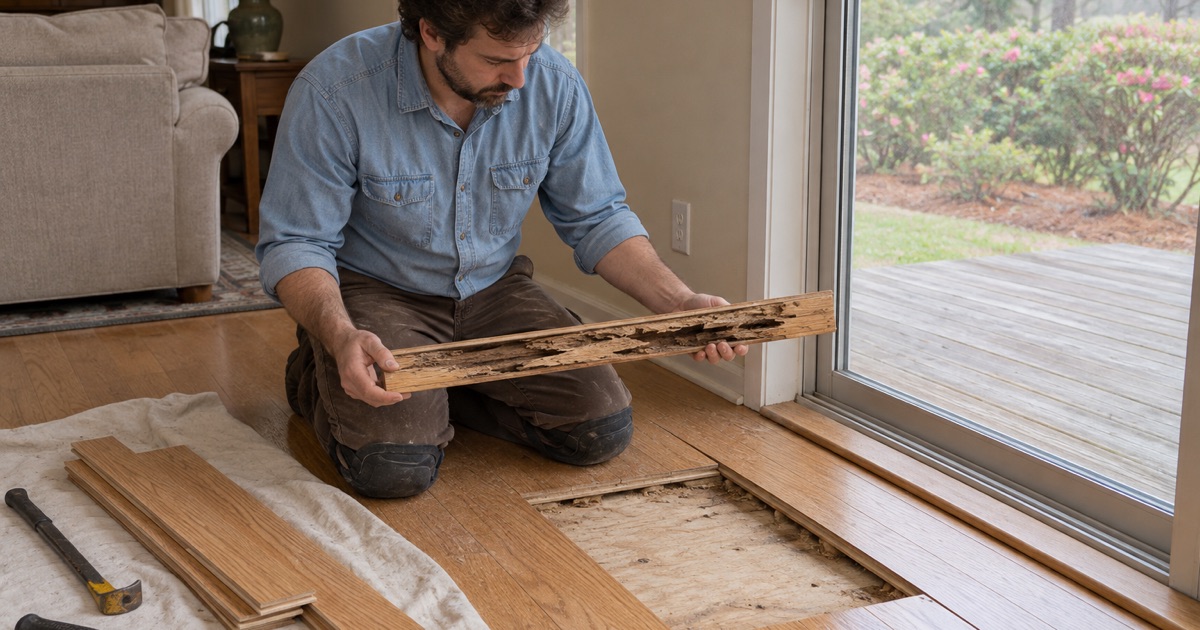
Boards that sound hollow when tapped, or feel soft or spongy underfoot, are one of the first signs of termite damage. Termites leave the top surface intact while eating the wood behind it, so the damage is much larger than it looks.
We probe suspect boards with a thin tool and tap along the floor to map the hollow area. Where the probe sinks easily, the wood has been eaten and has to be replaced.
Blistering, Buckling and Rippled Finish
Termite damage can make a finished floor look blistered, rippled or slightly buckled, similar to water damage. The moisture termites bring into the wood can also cause cupping near the affected area.
Because those signs overlap with water damage, we check moisture as well as the wood itself. Knowing which problem you have changes who needs to be called first, and in what order the repairs happen.
Mud Tubes and Termite Swarmers
Mud tubes along the foundation, on the walls of a crawlspace or along baseboards are a sign subterranean termites are traveling into the house. Termite swarmers, the winged insects that appear in spring, or piles of their shed wings near windows and doors, are another warning.
If you see either, call a pest control company before calling us. Treating the colony comes first; the floor repair follows once the house is protected.
Repairing the Floor After Treatment
Why Treatment Comes First
Replacing boards before treatment risks the new wood being attacked by the same colony. It can also cover damage the pest control company needs to see to plan the treatment.
We ask for confirmation that treatment has been completed before we start. Where a termite bond is in place, that paperwork usually comes from the same company that holds the bond.
Cutting Out Damaged Boards
We remove damaged boards completely, cutting them out along their length rather than cutting a square patch. That lets the new boards be woven into the floor with staggered joints, following the pattern of the original installation.
Every damaged board comes out. Leaving a partly eaten board in place, or filling it with wood filler, leaves a weak spot that will crack or sink under a heavy piece of furniture.
Subfloor and Joist Damage
Termites often reach the subfloor before they reach the finished boards, and sometimes the joists below. Once the damaged flooring is out, we inspect everything underneath and replace damaged subfloor as part of the repair.
Where joists show significant damage, the structure may need a framing contractor or an engineer’s input before the floor goes back. We show you what we find and explain the options before the scope changes.
Matching and Finishing the Repair
Matching Species, Width and Age
We match the replacement boards to the original floor by species, width, thickness and grade. On older floors, including red oak, white oak and heart pine, we look for reclaimed boards that match the age and color of the wood around them.
Matching carefully at this stage is what makes the finished repair hard to find. A bright new board in the middle of an aged floor is exactly what we work to avoid.
Blending the Color
After the new boards are in, we sand the repaired area flat and blend the color with stain samples. On floors with a sound finish, we can sometimes refinish only the repaired section and blend it to a natural break such as a doorway.
Where the rest of the floor is worn, refinishing the whole room gives the most even result. We quote both so you can choose.
Termite Repairs, Home Sales and Bonds
The Termite Letter at Closing
In Georgia, the termite letter is the Official Georgia Wood Infestation Inspection Report. When it notes damage, the repair often has to be scoped and scheduled quickly to keep a closing on track.
We inspect the floor, provide a written scope both agents can use, and document the completed work. Who pays for the repair depends on the sale contract, so we give the same written scope to both sides.
What a Termite Bond Covers
A termite bond is a service contract with a pest control company. Some bonds cover retreatment only, while others include some repair of new damage. The terms vary, so read yours carefully.
We provide a written repair estimate you can submit under the bond or keep for your records. If the bond does not cover the floor, you still have a clear scope and price.
- 20+ Years on Wood Floors
- Moisture Readings Before Repairs
- Stain Samples on Your Floor