
Smyrna Wood Flooring handles hardwood floor installation in Smyrna, GA with more than 20 years of experience, serving surrounding cities including Vinings, Fair Oaks, Mableton, Marietta and Austell. We install solid hardwood from classic oak strip to wide plank and herringbone, over a subfloor we have checked, flattened and measured before the first board is nailed.
A new hardwood floor should last the life of the house and take several refinishes along the way. Whether it does depends less on the brand on the box than on what happens before installation: the moisture in the wood and subfloor, the flatness of the surface underneath, and the fastening pattern used to hold it down.
We help you choose the species, width and finish that suit the room and the way you live, then install to the NWFA Installation Guidelines and the manufacturer’s instructions. The result is a floor that stays tight, flat and quiet through Georgia’s humid summers and dry winters.
Choosing the Wood
Red Oak, White Oak and Hickory
Red oak is the traditional American floor, with an open grain that hides small dents and a warm tone under clear finish. White oak is a little harder, has a tighter grain and more muted color, and takes gray and brown stains more evenly, which is why it leads most current installs.
Hickory is harder still and has dramatic color variation from board to board. It suits rustic and busy homes, though its hardness makes it more demanding to sand and install. We bring samples of each so you can see them in your own light.
Janka Hardness and Real-World Wear
The Janka hardness scale measures how well a wood resists denting, and it is a useful guide when comparing species. It is not the whole story, though, because the finish takes most of the daily wear and even the hardest wood will scratch under dog claws or gritty shoes.
We use hardness to narrow the choice, then talk through your household honestly. A softer wood with lots of character may suit you better than the hardest option if a lived-in look is what you want.
Heart Pine and Reclaimed Wood
Heart pine and reclaimed longleaf pine bring deep color and a history no new board can match. They are softer than oak and will dent, and many owners see that as part of the appeal.
Reclaimed boards vary in width, thickness and moisture, so they need careful sorting and acclimation before installation. We inspect every bundle for nails, splits and insect damage before it comes into your home.
Board Width, Pattern and Layout
Strip, Plank and Wide Plank
Strip flooring, the narrow boards found in most older homes, is stable and classic. Plank and wide plank floors make rooms look larger and calmer, but wider solid boards expand and contract more with the seasons.
For wide plank solid floors, we check moisture more closely, adjust the fastening schedule and may add adhesive, so the boards stay flat without gapping. Where the conditions are not right for solid wide plank, we tell you and explain the engineered alternative.
Herringbone, Chevron and Parquet
Herringbone and chevron floors are set from a centered layout line, with every piece cut and fitted by hand, and parquet is laid in blocks or tiles in a repeating pattern. These floors take longer and cost more than straight-lay boards, and they reward careful planning.
We lay out the pattern on the subfloor before installing, so it runs square to the main sightline and meets doorways cleanly. A pattern that drifts a few degrees shows across a whole room.
Direction, Transitions and Trim
Boards usually run the length of the room or perpendicular to the floor joists for stiffness, and the direction affects how large a room looks. We plan the direction across connected rooms so the floor flows without awkward breaks.
Where the new floor meets tile, carpet or stairs, we install a reducer, threshold or stair nosing matched to the wood. An expansion gap is left at every wall and covered with base or quarter round, so the floor has room to move.
Preparing the Subfloor
Flatness, Squeaks and Fastening
A hardwood floor can only be as flat as the subfloor under it. We check for high and low spots, sand or fill them, and fix squeaks by securing the subfloor to the joists before any boards go down.
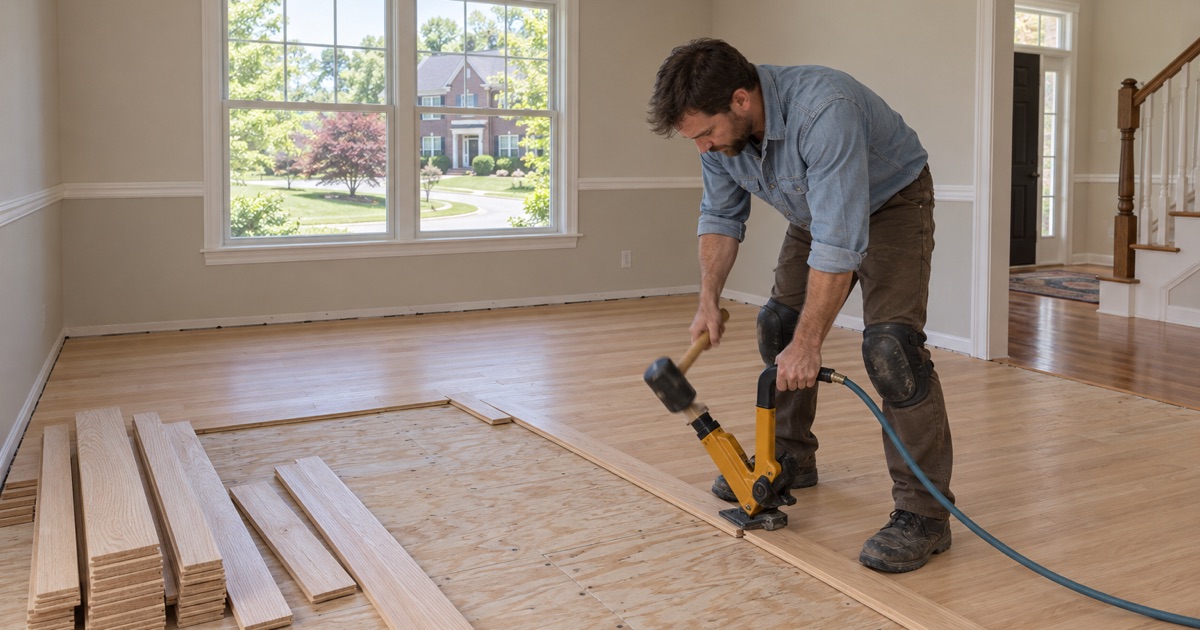
We then lay a moisture-appropriate underlayment and nail the boards with flooring cleats or flooring staples at the spacing the product calls for. Correct fastening is what keeps a floor from squeaking or loosening in the years ahead.
Moisture Readings and Acclimation
We take moisture meter readings on both the new boards and the subfloor, and we compare them before installing. Wood that is too wet will shrink and gap, while wood that is too dry will swell and cup once it takes on moisture from the house.
Acclimation brings the boards close to the home’s normal conditions. We install when the numbers say the wood is ready, not on a fixed countdown, and we record the readings for your warranty file.
Prefinished and Site-Finished Floors
Prefinished Hardwood
Prefinished hardwood arrives with a durable factory finish and can be walked on as soon as it is installed. There is no sanding dust or finish odor, which makes it a good fit for occupied homes and tight schedules.
The tradeoff is the small bevel on each board’s edge and a factory color that is harder to match to an existing floor. When the time comes to refinish, it can usually be sanded like any solid floor.
Site-Finished Hardwood
Site-finished floors are installed raw, then sanded flat and stained and finished in place. The surface is smooth and seamless, the color is chosen from stain samples on your own boards, and new rooms can be blended into an existing floor.
The work takes several more days and involves sanding and finish coats in the house. For many homeowners, the ability to match an existing floor exactly makes that worth it.
- 20+ Years on Wood Floors
- Moisture Readings Before Repairs
- Stain Samples on Your Floor